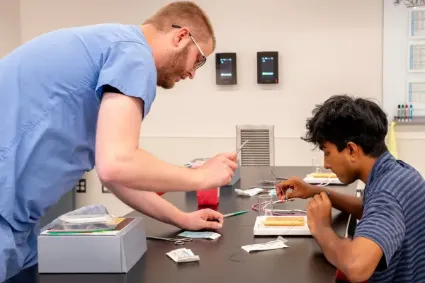
For most of the year, the Indiana University School of Medicine Department of Surgery Surgical Skills Center trains residents and faculty in surgical techniques. This summer, however, the simulation lab welcomed high school and college students to explore careers in medicine.
Students from the Indiana School for the Deaf joined high school and undergraduate interns from the Department of Surgery's Surgical Outcomes and Quality Improvement Center (SOQIC) to practice suturing, complete laparoscopic drills and learn alongside surgeons. The experience is part of the department's broader effort to provide hands-on exposure to academic surgery through research, mentorship and training.
"We're trying to excite young people about the field of surgery," said Karl Bilimoria, MD, MS, chair of the Department of Surgery. "Giving them exposure early on to the operating room, the clinic and the skills center shows them what life as an academic surgeon could be like."
For Thomas Gonzalez, a rising junior at Northwestern University and a SOQIC summer intern, the skills center reinforced an interest in surgery.
"It offers an opportunity where no two days will ever be the same," Gonzalez said. "Every day you come in, you're not sure how the operation will go. That's the part of surgery that really intrigued me."
Similarly, Purdue University biomedical engineering student, Justin Lockner, began the summer expecting to grow his research experience. Instead, he found himself drawn closer to patient care.
"I entered Purdue as a biomedical engineer and got exposed to the medical field," Lockner said. "Then I realized that I wanted to be more hands-on and work with patients. This pulled me further into medicine."
Expanding access to careers in medicine
This summer also marked the second consecutive year students from the Indiana School for the Deaf participated in the Skills Center experience, which is an initiative designed to increase access to careers many deaf students don’t have the opportunity to explore. Last year, five students participated in the program. According to Transition and Guidance Coordinator Mimi Fetzer, several of those students later changed their intended college majors to healthcare-related fields.
"Too often, deaf individuals aren't exposed to careers in medicine because there are so few opportunities available to them," Fetzer said. "We saw this as a chance to change that by giving our students meaningful, hands-on experience. It's already making an impact."
"The biggest thing that's required is communication access," Fetzer said. "Once communication is accessible, everything else opens up. All the opportunities open up from there."
Students spend the day working with interpreters while interacting with physicians, residents and researchers. They also participate in virtual "fireside chats" with deaf scientists and clinicians, allowing them to see professionals who have successfully navigated careers in medicine.
Building confidence through repetition
The impact of the experience was evident in the students' reflections after spending the day at the Skills Center. Returning participant Sarah remembered nearly giving up on one of the laparoscopic exercises during last year's program before finally succeeding. This summer, she approached the same challenge with confidence.
"I almost gave up, but I persisted, and then I was finally able to do it — that was last year," Sarah said. "This year, I was able to do it again, so I'm really proud of myself."
For fellow returning student, Emani, the experience strengthened a dream.
"I want to become a surgeon," she said. "More specifically, an orthopedic surgeon."
The future of the surgical workforce
Harikrishna Nakshatri, PhD, a faculty member in the Department of Surgery and co-lead of the NIH-supported summer training program, believes exposing students to surgery early helps them determine if the profession aligns with their interests before committing to years of education.
"Many students think about becoming researchers or physicians based only on what they've heard from family or friends," Nakshatri said. "Exposing students early to the practical aspects of being a researcher or clinician helps them decide, 'Am I cut out for this intense profession?'"
That philosophy reflects the mission of the Surgical Skills Center as an American College of Surgeons Accredited Educational Institute to cultivate excellence in surgical education through hands-on training, innovation and research while preparing healthcare professionals to deliver quality patient care.
"We hope students leave the Surgical Skills Center excited to continue learning and inspired to explore surgery and healthcare further," said Lisa Fisher, director of the Surgical Skills Center. "Our goal is for every participant to leave with new knowledge, lasting memories and an appreciation for the teamwork, innovation and dedication that define the profession."
For Gonzalez, Lockner, and Indiana School for the Deaf students Sarah and Emani, the future is bright with new confidence to imagine themselves on the other side of the operating table.