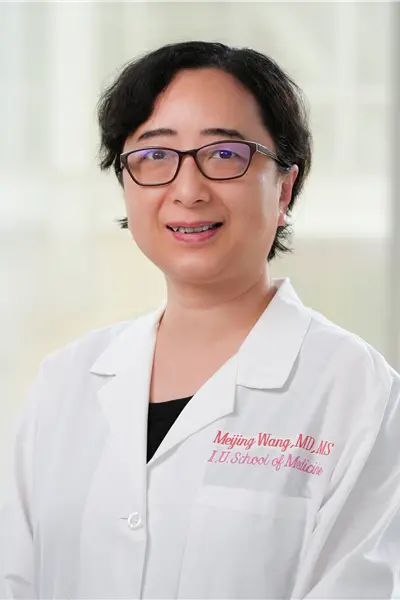
Meijing Wang, MD
Associate Professor of Surgery
Adjunct Associate Professor of Anatomy, Cell Biology & Physiology
- meiwang@iu.edu
- Phone
- 317-274-0827
- Address
-
R2 E319
SURC
Indianapolis, IN - PubMed:
-

Bio
Dr. Meijing Wang currently serves as Associate Professor of Surgery. She is also an Adjunct Associate Professor of Anatomy, Cell Biology and Physiology, and a Primary Investigator of Krannert Cardiovascular Research Center. Dr. Wang received her medical degree and master’s degree in Pediatric Hematology from West China University School of Medical Sciences, China.
Prior to joining Indiana University, Dr. Wang completed her residency in Pediatrics and fellowship training in Pediatric Hematology in China. She subsequently pursued postdoctoral research in myocardial ischemia reperfusion injury and stem cell therapy for ischemic heart disease in the Department of Surgery at Indiana University School of Medicine.
Dr. Wang’s research focuses on myocardial ischemia/reperfusion, inflammatory cardiomyopathy, and stem cell-based therapies for heart disease. She has served as a principle/co-investigator/contributor to more than 110 of peer reviewed publications.
Dr. Wang is a member of the American Heart Association, Shock Society, and International Society for Heart Research North American Section. She currently serves as an Academic Editor for PLOS ONE and an Associate Editor for Frontiers in Physiology. She has also served as an ad hoc reviewer for multiple NIH study sections and American Heart Association transformational project award review panels, as well as numerous scientific journals.
Key Publications
Wang M, Tsai BM, Crisostomo P, Meldrum DR. Tumor necrosis factor receptor 1 signaling resistance in female myocardium during ischemia. Circulation. 2006, 114 (S): I282-9.
Wang M, Crisostomo PR, Markel TA, Wang Y, Meldrum DR. Mechanisms of sex differences in TNFR2 mediated cardioprotection. Circulation, 2008, 118 (14S):S38-45.
Wang M, Tan J, Wang Y, Meldrum KK, Dinarello CA, Meldrum DR. IL-18 binding protein-expressing mesenchymal stem cells improve myocardial protection after ischemia or infarction. Proc Natl Acad Sci U S A. 2009 Oct. 106(41): 17499-504.
Huang C, Gu H, Wang Y, Wang M. Estrogen-induced SDF-1 production is mediated by estrogen receptor α in female hearts following acute ischemia and reperfusion. Surgery, 2011, 150(2): 197-203.
Huang C, Gu H, Zhang W, Manukyan MC, Shou W, Wang M. SDF-1/CXCR4 mediates acute protection of cardiac function through myocardial STAT3 signaling following global ischemia/reperfusion injury. Am J Physiol Heart Circ Physiol. 2011, 301(4): H1496-505.
Wang M, Qing Yu, Wang L, Gu H. Distinct patterns of histone modifications at cardiac-specific gene promoters between cardiac stem cells and mesenchymal stem cells. Am J Physiol Cell Physiol. 2013, 304(11): C1080-90.
Wang L, Gu H, Turrentine M, Wang M. Estradiol Treatment Promotes Cardiac Stem Cell (CSC)-Derived Growth Factors, Thus Improving CSC-Mediated Cardioprotection Following Acute Ischemia/Reperfusion. Surgery, 2014 Aug;156(2):243-52.
Zhang W, Qu X, Chen B, Snyder M, Wang M, Li B, Tang Y, Chen H, Zhu W, Zhan L, Yin N, Li D, Xie L, Liu Y, Zhang JJ, Fu XY, Rubart M, Song LS, Huang XY, Show W. Critical Roles of STAT3 in β-Adrenergic Functions in the Heart. Circulation, 2016 Jan 5;133(1):48-61.
Yang Y, Wang IW, Turrentine M, Wang M. Postischemic application of estrogen ameliorates myocardial damage in an in vivo mouse model. J Surg Res. 2018 Nov, 231:366-372. doi: 10.1016/j.jss.2018.05.076.
Wang M, Smith K, Yu Q, Miller C, Singh K, Sen CK. Mitochondrial Connexin 43 in Sex-Dependent Myocardial Responses and Estrogen-Mediated Cardiac Protection following Acute Ischemia/Reperfusion Injury. Basic Res Cardiol. 2020, 115(1):1. doi: 10.1007/s00395-019-0759-5.
Wang M, Yan L, Li Q, Yang Y, Turrentine M, March KL, Wang IW. Mesenchymal Stem Cell Secretions Improve Donor Heart Function Following Ex-vivo Cold Storage. J Thorac Cardiovasc Surg. 2022 Apr; 163(4): e277-e292. doi: 10.1016/j.jtcvs.2020.08.095.
Scott SR, March KL, Wang IW, Singh K, Liu J, Turrentine M, Sen CK, Wang M. Bone marrow- or adipose-mesenchymal stromal cell secretome preserves myocardial transcriptome profile and ameliorates cardiac damage following ex vivo cold storage. J Mol Cell Cardiol, 2022 Mar; 164: 1-12. doi: 10.1016/j.yjmcc.2021.11.002.
Scott SR, Singh K, Yu Q, Sen CK, Wang M. Sex as Biological Variable in Cardiac Mitochondrial Bioenergetic Responses to Acute Stress. Int J Mol Sci. 2022 Aug 18;23(16):9312. doi: 10.3390/ijms23169312.
Bhaskara M, Anjorin O, Yoniles A, Liu J, Wang M. Importance of Per2 in cardiac mitochondrial protection during stress. Sci Rep. 2024 Jan 14;14(1):1290. doi: 10.1038/s41598-024-51799-w.
Harvey BI, Yoniles AM, Mondivais A, Du J, Zadorozny L, Yu Q, Wang M. Sex-Specific Differences in LPS-Induced Rapid Myocardial Dysfunction. Int J Mol Sci. 2025 Jun 21;26(13):5963.
Du J, Yu Q, Anjorin OE, Wang M. Age-Related Mitochondrial Alterations Contribute to Myocardial Responses During Sepsis. Cells. 2025 Aug 7;14(15):1221. doi: 10.3390/cells14151221.
| Year | Degree | Institution |
|---|---|---|
| 2000 | MS | West China University of Medical Sciences |
| 1994 | MD | West China University of Medical Sciences |
One of Dr. Wang’s primary research focuses is to investigate the roles of sex and sex hormones in modulating myocardial responses to acute ischemia reperfusion injury, inflammation, endotoxemia, and sepsis, as well as to identify potential therapeutic interventions. Her group has demonstrated sex-related differences in myocardial inflammation, cell death, and cardiac function following acute ischemia reperfusion injury, including protective effects of estrogen in female hearts. More recently, they observed distinct patterns of cardiac metabolic regulation in male and female hearts during sepsis.
Another long-standing focus of Dr. Wang’s research is the evaluation of stem cell-derived therapies to improve cardiac functional recovery after myocardial ischemia. Her laboratory was among the first to investigate the use of mesenchymal stem cell-derived condition medium and exosomes to modify standard preservation solutions for donor heart storage. These efforts may lay the ground for developing cell-free, stem cell secretome-based therapies to optimize current organ storage methods in heart transplantation.