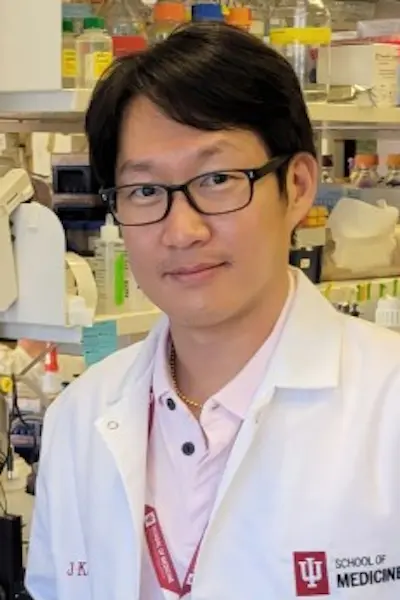
Byungwook (BK) Kim, PhD
Assistant Research Professor of Medical & Molecular Genetics
MS
- Phone
- (317) 278-6353
- Address
-
NB 108
MMGE
IN
Indianapolis, IN - PubMed:
-

Bio
Dr. Kim earned his MS degree in 2010 and completed his PhD in 2014, both from KonKuk University in Korea. During his predoctoral training, he investigated the development of immune-based therapeutics to treat neuroinflammation and neurodegenerative diseases, with a particular focus on Parkinson's disease (PD). During his initial postdoctoral training in Korea, his research continued to focus on neuroinflammation and glia-mediated pathogenesis in PD. In this role, he conducted research utilizing post-mortem brain tissues from PD patients and mouse models of PD, including neurotoxin models such as 1-methyl-4-phenyl-1,2,3,6-tetrahydropyridine (MPTP) and 6-hydroxydopamine (6-OHDA).
In 2016, Dr. Kim joined Dr. Jungsu Kim's laboratory at the Mayo Clinic in Jacksonville, Florida, as a postdoctoral researcher. This move allowed him to broaden his expertise in neurodegenerative diseases by shifting his focus to Alzheimer's disease (AD) research. He then transitioned with Dr. Jungsu Kim's laboratory to the Stark Neurosciences Research Institute at the Indiana University School of Medicine in 2018.
Dr. Byungwook Kim now serves as an Assistant Research Professor in the Department of Medical and Molecular Genetics at the Indiana University School of Medicine. His current research endeavors are dedicated to understanding the roles of microRNAs, the AD genetic risk factor SPI1, and lipid-regulating proteins in the pathogenesis of AD.
Key Publications
All publications: https://www.ncbi.nlm.nih.gov/myncbi/byungwook.kim.1/bibliography/public/
Select publications:
- Park JH, Kim B, Al-Amin MM, Tate MD, Sharify AD, John SK, Karahan H, Lu HC, Dabin LC, Kim J. (2026) Unique transcriptomic alterations in 5XFAD;PS19 mouse model identify glial lipid dysregulation and coordinated microglial-oligodendrocyte responses. Alzheimer's & Dementia. 22, e71742.
- Kim B, Tate MD, Karahan H, et al. (2026) Deletion of SPI1 in microglia exacerbates amyloid pathology by impairing microglial response in Alzheimer’s disease models. Neuron, 114; 1-18.
- Al-Amin MM, Kim B, Karahan H, et al. (2025) Apolipoprotein ε4 exacerbates white matter impairment in a mouse model of Aβ amyloidosis by decreasing actively myelinating oligodendrocytes. Alzheimer's & Dementia. 21(10):e70791.
- Cho DY, Han JH, Kim IS, et al. (2025). The acetyltransferase GCN5 contributes to neuroinflammation in mice by acetylating and activating the NF-κB subunit p65 in microglia. Sci Signal. 18(876):eadp8973. (Co-Corresponding author)
- Tate M, Wijeratne HRS, Kim B, et al. (2024). Deletion of miR-33, a regulator of the ABCA1-APOE pathway, ameliorates neuropathological phenotypes in APP/PS1 mice. Alzheimers Dement. 20(11):7805-7818.
- Kim B, Dabin LC, Tate MD, et al. (2024). Effects of SPI1-mediated transcriptome remodeling on Alzheimer’s disease-related phenotypes in mouse models of Aβ amyloidosis. Nat Commun. 15(1):3996.
- Lancaster MS, Kim B, Doud EH, et al. (2023). Loss of succinyl-CoA synthetase in mouse forebrain results in hypersuccinylation with perturbed neuronal transcription and metabolism. Cell Rep. 42(10):113241.
- Karahan H, Smith DC, Kim B, et al. (2021). Deletion of Abi3 gene locus exacerbates neuropathological features of Alzheimer's disease in a mouse model of Aβ amyloidosis. Sci Adv. 7(45):eabe3954.
- Kim B, Park JY, Cho DY, et al. (2020) 2-(5-(4-Chlorophenyl)-1-(2,4-dichlorophenyl)-4-methyl-1H-pyrazol-3-yl)-N-(2-hydroxyethyl)-2-oxoacetamide (CDMPO) has anti-inflammatory properties in microglial cells and prevents neuronal and behavioral deficits in MPTP mouse model of Parkinson's disease. Neuropharmacology. 166:107928.
- Kim BW, Jeong KH, Kim JH, et al. (2016) Pathogenic upregulation of glial lipocalin-2 in Parkinsonian dopaminergic system. J Neurosci. 36(20):5608-22.
- Kim BW, Sandeep M, Yun YS, et al. (2016) A novel synthetic compound MCAP suppresses LPS-induced murine microglial activation in vitro via inhibiting NF-kB and p38 MAPK pathways. Acta Pharmacol Sin. 37:334-43.
- Kim BW, Koppula S, Kumar H, et al. (2015) α-Asarone attenuates microglia mediated neuroinflammation by inhibiting NF-kB activation and mitigates MPTP-intoxicated behavioral deficits in a mouse model of Parkinson’s disease. Neuropharmacology. 97:46-57.
| Year | Degree | Institution |
|---|---|---|
| 2014 | PhD | Konkuk University |
| 2010 | MS | Konkuk University |
| 2008 | BS | Konkuk University |
Dr. Kim’s research interests include neurodegenerative diseases, specifically Alzheimer’s disease, Parkinson’s disease, and microglia-mediated neuroinflammatory disorders. Another line of his research focuses on understanding the roles of microRNAs, the AD genetic risk factors, and lipid-regulating proteins in the pathogenesis of AD and PD.
Desc: Developmental Project Program (P30 AG072976)
Scope: National
Date: 2025-07-01
Desc: 2021 Alzheimer's Association Research Fellowship (AARF-21-852175)
Scope: International
Date: 2021-10-01