
WHILE IU SCHOOL OF MEDICINE restructured its curriculum in 2017, the first year is still built upon courses that are dense and demanding, it’s vital to supply students with an understanding of the body’s terrain, a precise grasp of its function, the language of their profession and the habits of learning expected of a physician.
But at times, it’s almost overwhelming. The PLCs, as they are known, are designed to fill in gaps. Bill Swigart, MD, a faculty advisor to the Hickory community, said a colleague once summed it up this way: “We spend a lot of time teaching students what to do as a doctor. But not enough time talking about who to be.”
The faculty advisors fulfill a key role in bridging the gap.
For the Dogwood community, Megan Crittendon, MD, and Brent Bagley, MD, fill those roles. They host monthly Doc Talks — hour-long discussions to help students form professional identities.
They invite students to occasional dinners and holiday gatherings and serve as sounding boards.
“I’m not the one teaching their courses,” Bagley said. “I’m not the one writing their tests and grading them. I’m the one who they can talk to about their life in medical school, who they can talk to about the stuff that they don’t teach you about being a doctor.”
Jordan Walker, a third-year student in the Dogwood community, values the insights he’s gained from Crittendon on emergency medicine, a specialty he’s considering. But the mentors’ unofficial influence is also helpful and comes without the complications of grading or evaluation.
At a recent Doc Talk, each community spent time discussing a topic that’s addressed in the formal curriculum only in spots: managing the emotional aspects of being a physician.
In the safe confines of the Dogwood suite, Crittendon, Bagley and their first-year students covered expansive ground. They discussed giving a patient bad news, managing a room with family members when emotions are high, and coping with the loss of a patient.
Questions flowed quickly.
When is humor appropriate with an anxious patient?
“It’s reading the room,” Crittendon said.
How do you know if a patient understands what you’re saying?
“I start by asking what they’ve heard,” Bagley said. “Then I steal their words.”
How do you handle difficult conversations?
“Watch as many as you can,” Crittendon tells them. “You’ll learn what to do — and what not to do.”
Then, the conversation shifted. One student described witnessing the death of a 9-month-old while shadowing in a pediatric emergency room. The room stilled. “I’ve definitely cried in front of patients,” Crittendon said.
“That’s totally OK,” Bagley said.
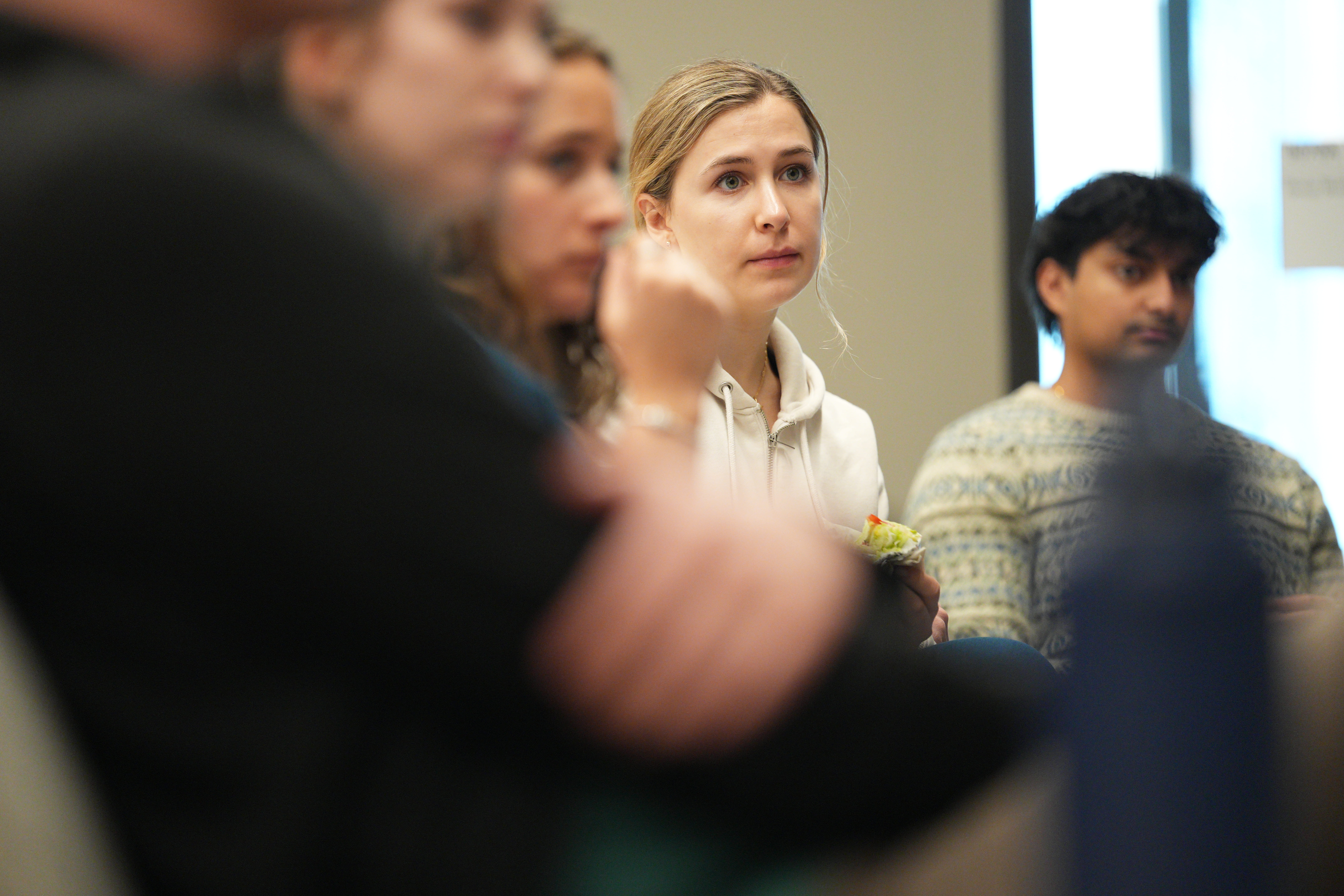
At a recent Doc Talk, first-year students and their faculty advisors covered expansive ground: giving patients bad news, managing grief, and knowing when it's OK to cry. "That's totally OK," Brent Bagley, MD told them.
IT IS NOT the kind of exchange that would have been common in medical training a generation ago. Here, it is the whole point.
The doctors’ willingness to acknowledge the pain and tears of the job was well received by the students. So were the moments when Bagley and Crittendon admitted to stumbling over their words in patient chats and to sometimes making mistakes.
“You have to have that in medicine. You’re not perfect,” said Brynn Baker, who just finished her first year. “If you don’t have humility, your patients won’t trust you. We’re not here to play God.”
So, in the end, how does having a Professional Learning Community in a big medical school — and giving it dedicated space — help shape better doctors?
“It’s the idea of moving them from being a student to identifying as a physician,” said Weinstein, the PLC director. “It’s building the skill sets that this requires, the ethos involved and the responsibility to the community at large that comes with that.”