
Yet, the journal club is more than coffee talk over heavy subjects. Today, a pair of fellows present two new journal articles, offering critiques while faculty experts chime in. Together, they dissect clinical trial data, including patient survival rates and adverse reactions, methodologies, conclusions and potential conflicts of interest. The critiques aren’t typically savage, but the club isn’t shy about calling out flawed methods, bias and overly favorable presentation of results.
From his seat at the head of the table, Einhorn tries to gently coax discussion from the fellows. He’s content to let faculty members like physicians Nasser Hanna, Bryan Schneider and Shadia Jalal — all fellowship graduates themselves — steer the conversation. But when needed, Einhorn doesn’t hesitate to point out serious issues. In one article, he noted a disclosure that the researchers had received help writing their paper from the drug’s manufacturer.
“First authors should write it themselves,” Einhorn said. “Industry does a great job, and they want to help patients, but they wear a different hat than academics do.”
For Jacob Edmisson, MD, a second-year fellow whose residency was at Washington University in St. Louis, watching Einhorn analyze science and spot key elements of clinical trial design has been revelatory. “This is someone who has been so successful in his career,” he said. “Being able to see how he dissects these things has definitely changed how I view and read articles.”
Ben Snyder, MD, a third-year fellow who completed his residency at IU, agrees. He said Einhorn’s skill lies in praising what’s strong and dissecting what’s not. “He is the mentor of all mentors,” Snyder said.
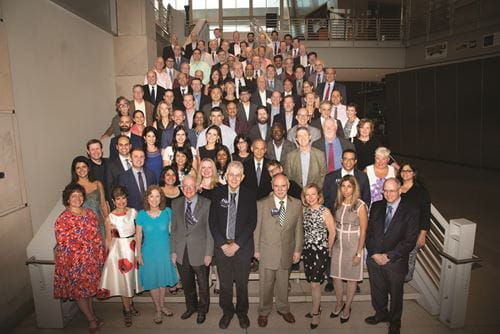
ROBIN ZON, MD, a 1998 fellowship graduate, would later be elected president of the American Society of Clinical Oncology, considered the world’s leading professional organization for physicians who care for people with cancer. Zon said she still scrutinizes research journals using the skills she learned in journal club — and cancer specialists recognize it as a signature of Einhorn’s training. In the oncology community, she said, “People know that if you come from IU, you’re well trained.”
Christopher Sweeney, MBBS, DHS, a 1999 fellowship graduate who now leads a cancer center in his native Australia, said the journal club helped him learn how to extract the truth. “The value is to really understand the core nuggets of the scientific advance while realizing the work that still needs to be done,” he said.
Beyond journal club, Sweeney said he learned research principles from Einhorn that still guide his work today. “I say without any hesitation: It was clearly the most influential times in my formative years as an oncologist and a cancer researcher and still guides how I practice as an oncologist and conduct research more than 25 years later,” he said.