Kyle Gospodarek got a fresh buzzcut before speaking at the Hydrocephalus Association’s national conference in Indianapolis. He wanted maximum exposure of the contrasting scar line that runs from the base of his neck up the back of his skull — a testament to his journey with this medical condition that causes abnormal buildup of cerebrospinal fluid in the brain’s ventricles.
Since his initial diagnosis at age 6, he has endured 68 surgeries for his complex case. Today, Gospodarek, MD, MSEd, is an assistant professor of clinical family medicine at Indiana University School of Medicine—Northwest-Gary. The medical complications of living with hydrocephalus made completing his MD challenging, but focusing on that goal gave him a reason to keep pushing for recovery.
Now he has discovered his passion as an educator.
“I always had a great support network with my friends and family,” he said. “One of my favorite things now, as a professor, is to be a support system for my students.”
Through his connections with the Hydrocephalus Association, he’s also supporting patients and families living with this debilitating medical condition. Gospodarek and other IU faculty worked to bring the association’s national conference to Indianapolis this year, gaining the support of Riley Children’s Health and IU Indianapolis as presenting sponsors.
The HA Connect National Conference on Hydrocephalus brings together medical professionals and scientists with people living with the disease and their caregivers. About 600 participants are registered. Gospodarek is presenting a session on advocating for yourself or your child and partnering with care team. He’s also part of a “real talk” panel discussion for patients and caregivers on what it’s like to grow up with hydrocephalus — a life-threatening condition that affects more than 1 million Americans.
Although anyone can develop it at any age, hydrocephalus is the most common reason for brain surgery in children. According to the Hydrocephalus Association, one out of every 770 babies will develop the condition.
“The conference offers so much,” Gospodarek said. “When you have a meeting of all these people who are afflicted by a similar disease pathology that has a profound impact on our lives, getting the opportunity to get to know those individuals from around the country and getting to spend time with them is incredible.”
Gospodarek also spoke at last year’s HA conference in Tampa, Florida. Afterward, several parents told him how his story inspired them and gave them hope for their child’s future. “That tore me apart in the best way,” he said.
“I like to tell people they have the diagnosis, but the diagnosis does not have them — and they are not defined by it,” he added. “Keep pushing.”
68 surgeries and counting
Gospodarek’s medical odyssey began when a 27-inch TV fell on his head, cracking his skull when he was 6 years old. While investigating the head trauma, his medical team discovered an aneurysm unrelated to the injury, which they later determined was due to a genetic defect.
 When the aneurysm ruptured, Gospodarek developed hydrocephalus. He had multiple surgeries before his seventh birthday — the day he received a new shunt that kept him surgery-free for the next nine years.
“It was the best birthday present I could have asked for,” he said. “It was a good run.”
When the aneurysm ruptured, Gospodarek developed hydrocephalus. He had multiple surgeries before his seventh birthday — the day he received a new shunt that kept him surgery-free for the next nine years.
“It was the best birthday present I could have asked for,” he said. “It was a good run.”
During his sophomore year of high school, he began experiencing severe headaches, a symptom which has persisted into adulthood. He had a shunt revision surgery and was doing well with plans to go to Purdue University to study veterinary medicine. Three days before the start of the semester, Gospodarek woke up with a shunt infection that resulted in bacterial meningitis. He was forced to delay the start of his college education for another year.
Since his family home is in northern Indiana, most of Gospodarek’s medical care was affiliated with a children’s hospital in Chicago. He decided to live at home while completing his undergraduate degree at Purdue’s Northwest campus in Westville. After shadowing several doctors, Gospodarek’s interest shifted from treating animals to humans.
He had plenty of experience being in hospitals. “I looked up to my care team and idolized my neurosurgeons,” he said.
By the end of college, Gospodarek’s health had improved, and he was accepted to IU School of Medicine, where he completed his medical education on the Northwest-Gary campus. But again, medical complications prolonged his path.
“It took six years because of a stroke I experienced during a brain surgery in 2012,” he recalled. "I had to take a year off to rehab and then had a slew of surgeries in the middle of my third and fourth years.”
The biggest challenge from the stroke was paralysis of his right side. Through physical therapy and determination, Gospodarek slowly regained function, but never fully in his right hand — his dominant hand. That ruled out some medical specialties like surgery.
Gospodarek naturally gravitated toward neurology but had to withdraw from the Match process due to another shunt malfunction and more surgeries. A year after achieving his MD, Gospodarek would discover his passion for teaching when one of his former professors told him about an opening in medical education at the Northwest campus.
“They wanted to have someone who was clinically trained teaching some of the basic sciences, and it turned out I absolutely loved it,” he said. “It was a very happy accident, and I’ve been doing it ever since.”
Managing hydrocephalus is still a part of Gospodarek’s daily life. Recently, he was proctoring an exam for students in his Foundations of Health and Disease course when he experienced a seizure.
“I woke up with my head on my podium and students patting me on the back,” he recalled. “They kept me upright and safe. They did a great job.”
Hope for a shunt-free future
Over the last 30 years of living with hydrocephalus, Gospodarek has seen many improvements in treatments and shunt technology. A common problem is shunt failure and infections, leading to multiple brain surgeries over a patient’s lifetime.
Shunts are implanted into the brain to divert excessive cerebrospinal fluid to other parts of the body where it can be absorbed. According to the Hydrocephalus Association, a shunt surgery is performed every 15 minutes in the U.S., and about 50% of shunts in pediatric patients fail within two years of placement.
“A lot of research is being conducted about different ways to reduce shunt malfunction and reduce the need for revisions and reduce infections,” Gospodarek said. “And there are a lot of research angles trying to eliminate shunts entirely, but we’re not there yet.”
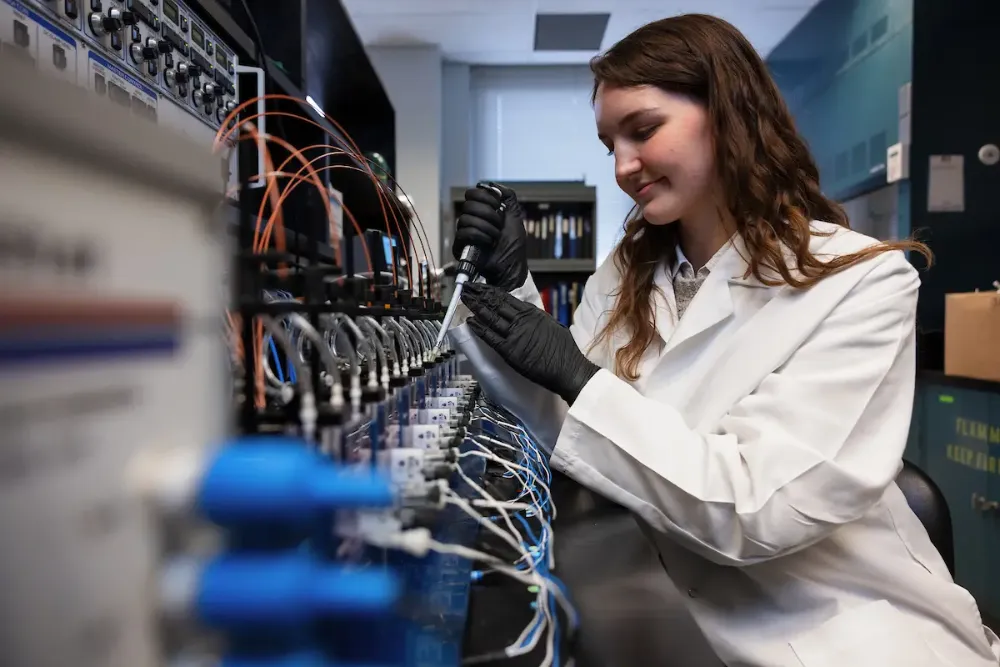
Bonnie Blazer-Yost, PhD, director of the Hydrocephalus Research Center at IU, has devoted her research to doing just that. Her team is giving lab tours and presenting the latest scientific discoveries during the July conference.
“Our research in the center is laser-focused on developing non-surgical treatments for hydrocephalus,” said Blazer-Yost.
The center employs about 30 scientists across multiple disciplines all working to develop the first effective drug treatment for hydrocephalus. Their research is backed by a $11.7 million grant from the Department of Defense. The group is studying TRPV4 antagonists, which have shown the ability to reduce the production of excess cerebrospinal fluid in tissue cultures and potentially reduce neuroinflammation.
 One of the center’s goals is to develop models for each of the various types of hydrocephalus. People can be born with hydrocephalus caused by spina bifida, brain malformations or other diseases, or they can acquire hydrocephalus from head injuries, brain tumors, brain bleeds or infections of the brain or spinal cord. Older adults can also develop hydrocephalus as they age.
“If we’re able to develop relevant models for all types of hydrocephalus, it will make us very unique,” Blazer-Yost said.
While drug therapies are on the horizon, shunts remain the primary treatment for hydrocephalus. As an experienced pediatric neurosurgeon, Laurie Ackerman, MD, has seen tremendous innovation in shunt technologies over the past 30 years.
“There are now antibiotic catheters that reduce infections, tubing that breaks less frequently, and programmable valves that allow for switches in shunt pressures without having to have surgeries,” said Ackerman, the John E. Kalsbeck Professor of Pediatric Neurosurgery at IU School of Medicine. “The technology keeps improving things, but we have a long way to go.”
Excitingly, she said, the advent of endoscopic third ventriculostomy (ETV) may allow some hydrocephalus patients to be shunt-free by creating a small opening in the ventricular system to drain excess fluid, eliminating the need for shunt tubing.
Another new technology is on display at the conference in Indianapolis. People with hydrocephalus will have the opportunity to sign up for a Rhaeos clinical study evaluating FlowSense, a non-invasive, wearable skin sensor that can be placed over a shunt to detect cerebrospinal fluid shunt flow.
Ackerman credited the Hydrocephalus Association’s Clinical Research Committee for its continued work to advance care options for people living with the disease. She serves on the HA conference’s Medical Host Committee, along with Gospodarek and Daniel Fulkerson, MD, a neurosurgeon with Beacon Health System and adjunct clinical associate professor of neurological surgery at IU School of Medicine.
“I think there is always wisdom to be gained by putting many heads together, particularly when the heads gathering are patients and families, physicians and other healthcare providers, and importantly, researchers working on solutions for hydrocephalus treatment,” Ackerman said. “Absorbing the information others bring from their unique perspectives makes all of us better.”