Impact stories and awards show the school’s mission in action
Indiana University School of Medicine Dean Scott D. Boden, MD, provided schoolwide updates during his first All School Meeting since becoming dean on Sept. 8.
He began by thanking Michael Feldman, MD, PhD, for his leadership as interim dean and former Dean Jay L. Hess, MD, PhD, MHSA, for his steady leadership during his tenure of nearly 13 years.
“I’m not going to stand here and give you a State of the School address after just arriving,” said Boden, adding that his goal is to listen and learn. “I want to tell you a little about why I’m so excited to be here, share some of what I’m beginning to see, and talk about how I’m approaching these first few months.”
Why IU School of Medicine
While the allure of leading the largest allopathic medical school in the United States was real, it wasn’t mere size that brought Boden to IU. It was the medical school’s “unusual combination” of strengths: an outstanding educational mission and environment for training physicians and other health professionals; impactful research with a documented history and “enormous future” for translating discovery into better health; and deep clinical partnerships providing the opportunity to connect medical education and research discoveries to patient care.
“And we have something particularly distinctive,” he added, “a truly statewide educational model: Nine campuses, one school.”
Already, in his first 22 days, Boden has visited three of the school’s regional campuses, and he plans to visit the other five by the time he reaches 50 days. He sees the medical school’s statewide footprint as one of its greatest assets.
“I came because of an opportunity to build on something very strong — and make it even stronger,” he said.
Boden’s listening tour
 As he visits each campus, Boden is discovering its unique strengths and identifying opportunities worth developing.
“If we use that statewide reach intentionally, I think it gives us an extraordinary opportunity, not only to educate differently — and better — but to strengthen the physician and healthcare workforce and improve Hoosier health throughout Indiana,” he said.
When Boden visits a campus, he asks a lot of questions. He wants to know what makes people proud to be part of the IU School of Medicine — what the school is doing exceptionally well — as well as what it should be doing better to make sure talented people don’t encounter unnecessary barriers.
“I want to listen carefully enough so that what we ultimately choose to pursue is informed by the people who understand this institution best,” he said.
Opportunities ahead
Some opportunities have already caught Boden’s attention. He sees potential for innovating in education, broadening all Hoosiers’ access to healthcare, accelerating the pipeline from lab research to clinical trials, and growing infrastructure for “ambitious science.”
“We need to understand how new tools, including AI and big data, can genuinely improve education, research and health,” Boden said.
IU School of Medicine already has a strategic framework built around three pillars: maximizing learner success, accelerating discovery and translation, and improving health throughout the state. Boden wants to build upon those commitments.

“Part of good strategy is deciding what deserves extraordinary attention — and what does not,” he said. “Over the coming months, the issues of focus and prioritization are ones I expect we’ll spend a lot more time discussing together.”
A culture built together
Institutes, buildings and programs are nothing without smart, dedicated people running them. Boden called out the efforts of faculty who teach and mentor, the researchers who pursue life-changing discoveries, the staff who enable the school’s complex work, and the learners “who continually remind us why this mission matters in the first place.”
He also mentioned the school’s clinical and community partners, who make all of the school’s missions possible by providing meaningful connections across Indiana.
A strong culture is built when everyone works together, he said. Boden wants IU School of Medicine to be a place where high achievement is celebrated, difficult questions are asked, collaboration is rewarded, experiments are thoughtfully conducted, and good ideas get executed.
“I hope we can be ambitious without becoming distracted, candid without becoming cynical, and impatient for improvement without losing appreciation for everything that has already been accomplished,” he said.
The IU School of Medicine impact
Stories demonstrating IU School of Medicine’s regional, national and global impact were shared throughout the meeting.
“We want to highlight what our mission looks like in action — through the people and programs making an impact across our school and across Indiana,” said Neil Purdue, PhD, executive associate dean for strategy and enterprise alignment and the dean’s primary advisor for strategic operations.

Last spring, medical student Lucia Li worked alongside health department workers in Vigo County as part of a four-week Public Health Externship that IU School of Medicine has developed with health departments throughout the state. She saw firsthand how the public health team’s work in illness prevention — from disease testing in jails to restaurant and tattoo parlor inspections — intersects with the work of a physician.
“This is one way we are preparing our learners to provide better care and improve the health of the communities they serve,” said Perdue.
The second impact story focused on the telestroke program launched by IU School of Medicine’s vascular neurology team. Martinsville resident Brady Powers credits the expertise of Shaney Peña, MD, with potentially saving his life. Peña assessed Powers and advised his Martinsville care team remotely from Indianapolis, allowing Powers to quickly receive a clot-busting medication that is rarely administered at rural hospitals.
“Brady’s experience shows the power of our statewide mission: bringing specialized expertise to patients wherever they live,” said Perdue. “When seconds count, that expertise should not depend on ZIP code.”
The final impact story demonstrated what is possible when IU research expertise connects with industry and healthcare partners statewide.
This summer, the National Science Foundation selected an IU-led coalition to become one of the nation’s Regional Innovation Engines. This NSF IMPACT Engine brings together more than 170 partners from universities, health systems, industry, government and workforce organizations with the goal to accelerate innovation in musculoskeletal health.

Melissa Kacena, PhD, director of the Indiana Center for Musculoskeletal Health, was instrumental in securing the NSF engine. The coalition will connect Indiana’s research and clinical expertise with the state’s extraordinary strength in orthopedic manufacturing and life sciences.
The NSF engine will receive $15 million during its first two years, with the potential for up to $160 million in National Science Foundation support over a decade. The coalition aims to bring at least 30 innovations to market and generate more than $535 million in economic impact.
“This is research at its most powerful,” said Perdue, “bringing people and organizations together at a scale no single institution could achieve alone.”
Recognizing extraordinary people and publications
The second part of the meeting focused on faculty and staff recognition. Several faculty members were recognized for mentorship and inspirational teaching, among other areas of excellence. Staff awards included recognition for outstanding leadership, community engagement and cooperation.
Boden also initiated the IU School of Medicine 1K Pub Club to recognize researchers who have authored studies of high impact. This prestigious club honors faculty investigators whose peer-reviewed publications have been cited more than 1,000 times.
“Citations are one important measure of the influence a publication has had on subsequent research and on the direction of a field,” said Tatiana Foroud, PhD, executive associate dean for research affairs.
The inaugural class, honored during the All School Meeting, includes 45 faculty members. Some had multiple qualifying papers, making a total of 62 high-impact publications produced by current IU School of Medicine faculty. Notably, three faculty scientists each authored three publications which have been referenced over 1,000 times: Linda DiMeglio, MD, MPH, Bernardino Ghetti, MD, and Ronald Wek, PhD.
Other faculty researchers were recognized for national honors, which elevate IU School of Medicine’s reputation worldwide. Robert Considine, PhD, Patrick Loehrer, MD, and Jason Organ, PhD, were elected as 2026 fellows of the American Association for the Advancement of Science. Chandy John, MD, was elected to the National Academy of Medicine, and Mark Kelley, PhD, was named a fellow of the National Academy of Inventors. Suthat Liangpunsakul, MD, MPH, was elected to the Association of American Physicians.
Faculty and Staff Awards
IU School of Medicine Faculty Affairs and Professional Development recognized several award winners during the schoolwide meeting:
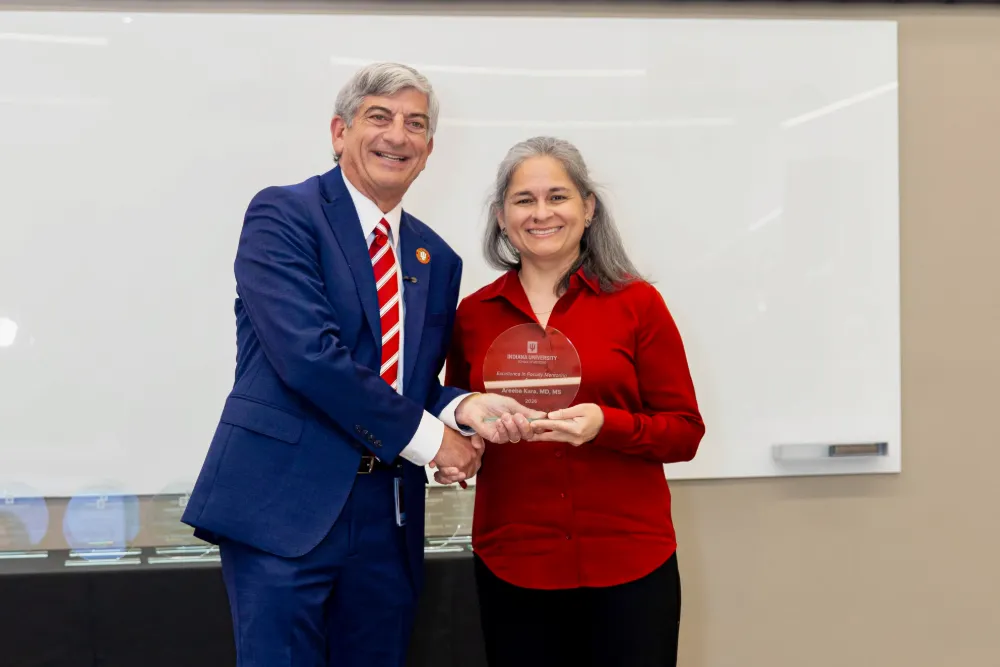
- Excellence in Faculty Mentoring: Areeba Kara, MD (Medicine) and Pierre Dagher, MD (Medicine)
- Outstanding Community Engagement: Tracey Wilkinson, MD (Pediatrics)
- Research Laboratory Excellence: Shannon Hawkins, MD, PhD (Obstetrics and Gynecology)
- Inspirational Educator: John Francis, MD (Surgery) and Brad Bohnstedt, MD (Neurological Surgery)
- Scholar Educator: Dimitrios Stefanidis, MD, PhD (Surgery)
Another 45 faculty members across all campuses were honored with Teaching Impact Awards. A complete list of all honorees may be viewed on the Faculty Affairs and Professional Development Awards page.
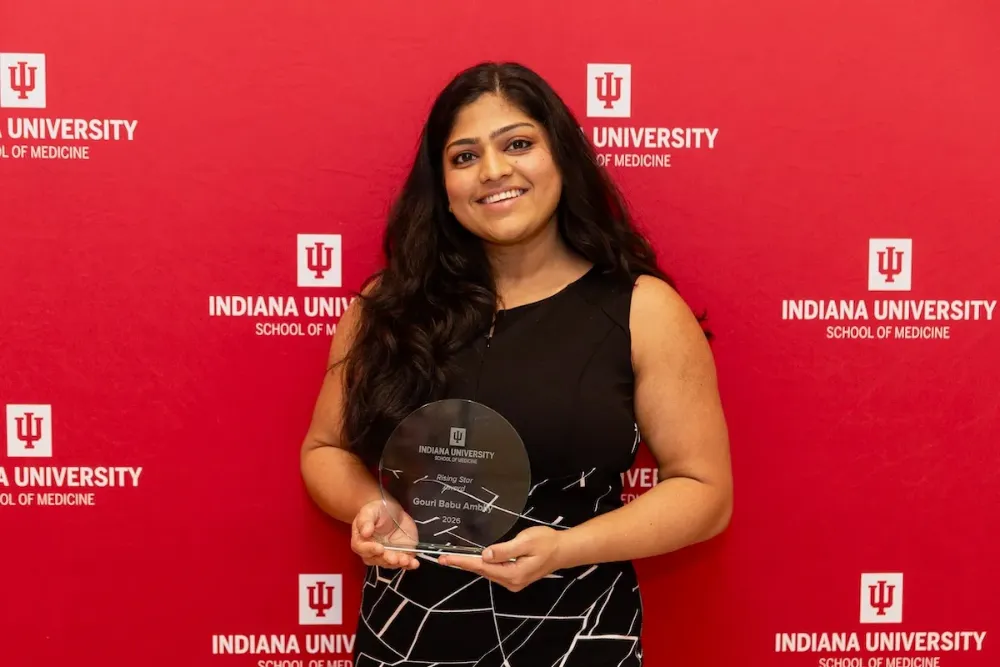
Six staff members were also recognized for their outstanding contributions in support of the school’s missions.
- Deb Cowley Staff Leadership Awards: Lane Cheslyn, center administrator for Children’s Health Services Research; and Jessica DellaRosa, SHRM-SCP, associate director of human resources for the Department of Pathology and Laboratory Medicine
- Lynn Wakefield Unsung Hero Awards: Ann Clark Egan, MS, LMHC, HEART lab program manager with Children’s Health Services Research; and Abi Colwell, MPH, CCRC, CPH, lead clinical research coordinator for medicine and clinical pharmacology
- Outstanding Community Engagement Award: Mackenzie Porter, MPH, early childhood intervention project manager in the Department of Pediatrics
- IU School of Medicine Rising Star Award: Gouri Babu Ambily, MA, clinical research coordinator in the Department of Psychiatry
 More information on staff awards and past winners may be found on the IU School of Medicine Staff Awards and Recognition page (MedNet login required).
Milestone anniversaries were also recognized at the meeting, including two staff members marking 40 years with the IU School of Medicine: Kristie Matteson, assistant to the chair in the Department of Pediatrics; and Lisa Wright, MS, CG, quality control and regulatory specialist and laboratory manager for Genetic Testing Laboratories.
Did you miss the meeting?
Watch the video of the IU School of Medicine Fall 2026 All School Meeting.