Gabriella Conjelko is that rare medical school student who started day one at the Indiana University School of Medicine knowing exactly what she wants to become: a pediatric oncologist.
First-year students are advised to keep an open mind about potential medical specialties, but Conjelko is certain nothing could alter her path. Failing to become a cancer doctor would mean breaking a promise to someone very special: her cousin Maia James, who died of Ewing sarcoma after just nine birthdays.
“She was feisty, she loved her people fiercely, and she had a very funny humor,” Conjelko said. “I spent the last moments with her, and I made that promise to her. It’s a promise I will never back down from — no matter what challenges may come.”
Conjelko is not only starting the journey toward her MD but is also building a nonprofit to fund pediatric cancer research. She launched Strides for Sarcoma with her twin brother, Nicholas, in 2024 with a benefit concert that raised over $12,000. Two years later, the nonprofit has raised over $150,000, benefitting both sarcoma research and the young “warriors” who battle childhood cancer.
When Maia’s cancer metastasized and relapsed, she was given what Conjelko calls a “gruesome” prognosis: a 0.7% chance of survival.
“That is when my twin brother and I looked at each other and said, ‘Clearly there’s a gap somewhere, and something needs to be done,’” she said. “The day that Maia relapsed, we started Strides for Sarcoma.”
Like his sister, Nicholas Conjelko is studying medicine and planning to become a pediatric oncologist; he is a first-year student at the Wood College of Osteopathic Medicine at Marian University in Indianapolis. “We wake up every single day thinking about Maia,” said Nicholas. “Not a single hour passes where a memory of Maia does not arise within our minds.”
The first Strides for Sarcoma grants went to three IU School of Medicine researchers: Karen Pollok, PhD ($7,500), Ed Greenfield, PhD ($2,500), and Christopher Collier, MD ($2,500). Each is investigating different types of sarcomas — biologically diverse and hard-to-treat cancers that develop in bones or soft tissues throughout the body.
“Support like this from the Strides community lets us generate key results quickly and moves us closer to better treatment options for children and young adults with osteosarcoma,” said Pollok, who used the grant to test a new kind of therapy targeting “replication stress” in tumor cells as they copy their DNA.
In May 2026, Strides awarded its inaugural Maia James Sarcoma Innovation Grant, a $40,000 award, to Pengda Liu, PhD. His lab at the University of North Carolina is working to develop a novel drug for treating relapsed Ewing sarcoma — the exact disease that claimed Maia’s life. Applications for the second Maia James grant, a $75,000 research award, will open in January 2027.
Bridging the gap: One family, two pediatric cancers
The family’s journey with childhood cancer didn’t start with Maia. Maia’s older brother, Maddox, was diagnosed with acute lymphoblastic leukemia (ALL) when he was 3 years old. Like Maia, Maddox endured years of hospital stays. Watching him ring the bell to celebrate the end of his cancer treatment on his seventh birthday was an unforgettable moment of triumph.
No one knew that a few years later, his little sister — born during Maddox’s  treatment — would be diagnosed with Ewing sarcoma, a completely unrelated cancer with much worse outcomes.
Walking through two different cancer battles with her family inspired Gabriella to pursue medicine. During her time as a premed student at Purdue University, she landed her first opportunity to work in cancer research and later did a summer internship at the IU School of Medicine working in Greenfield’s lab researching metastatic osteosarcoma, the most common bone cancer in children.
“I fell in love with research and really saw the promise behind it,” she said. “I mean, that’s how you get more therapies, that’s how you increase survival rates, that’s how you make new drugs that are going to fight cancer.”
Research funding is what led to successful treatments for Maddox’s leukemia, the most common type of childhood cancer. ALL now has a survival rate of 95%.
“We can’t say the same for Ewing sarcoma or any sarcoma,” Gabriella said. “Our goal is to one day make that survival rate 95% as well. And we know that can only be done with research.”
Greenfield’s lab at IU aims to repurpose FDA-approved drugs to prevent osteosarcoma from spreading to the lungs, which is the primary cause of death in kids with bone cancer. His team used the $2,500 Strides grant to fund preliminary studies that supported applications for larger federal and foundation grants.
“Increasing awareness and research funding is critical as pediatric cancer is targeted by less than 5% of the NIH cancer research budget,” Greenfield said. “Moreover, most pharmaceutical companies have not pursued drugs for pediatric cancers because the smaller number of patients creates economic disincentives.”
Further complicating the funding equation is that an effective treatment for one type of sarcoma might not work for a different type — or for a different patient even within the same disease category.
“Most pediatric sarcomas vary greatly between patients and will therefore likely require individual patients to be matched to specific drugs,” said Greenfield.
 As Gabriella and Nicholas advance in their medical training, they both hope to engage in sarcoma research alongside some of the scientific investigators Strides is funding.
“I don’t think Gabby and I would sacrifice so much of our time if we didn’t believe wholeheartedly that we would make a change in the world of pediatric cancers,” said Nicholas.
He remembers fondly a day when he was hanging out with Maia at a local park. As “the ringleader for any decision,” Maia insisted they explore a nearby woods. Soon they were lost amid the tall trees.
“I will never forget how loud we laughed as we got stuck in the mud, or the look on her face when she realized that maybe she couldn’t remember the path we had traveled,” recalled Nicholas. “It’s such a simple memory, but I think my mind always wanders there because it was a moment away from reality. It was amidst a relapse and a diagnosis where the fate of her life was unknown, where we just spent time together, just her and I, having fun. She got to experience, however short it may have been, what it felt like to be a child.”
Similarly, Gabriella remembers a time when Maia had just returned from Riley Hospital for Children without getting her planned chemotherapy treatment because her immune system was deemed too weak. Instead of lying down for the afternoon, Maia insisted Gabriella take her creek stomping in the backyard stream.
“Kids teach you that even in cancer, you still have to live,” Gabriella said.
Ways to support Strides for Sarcoma
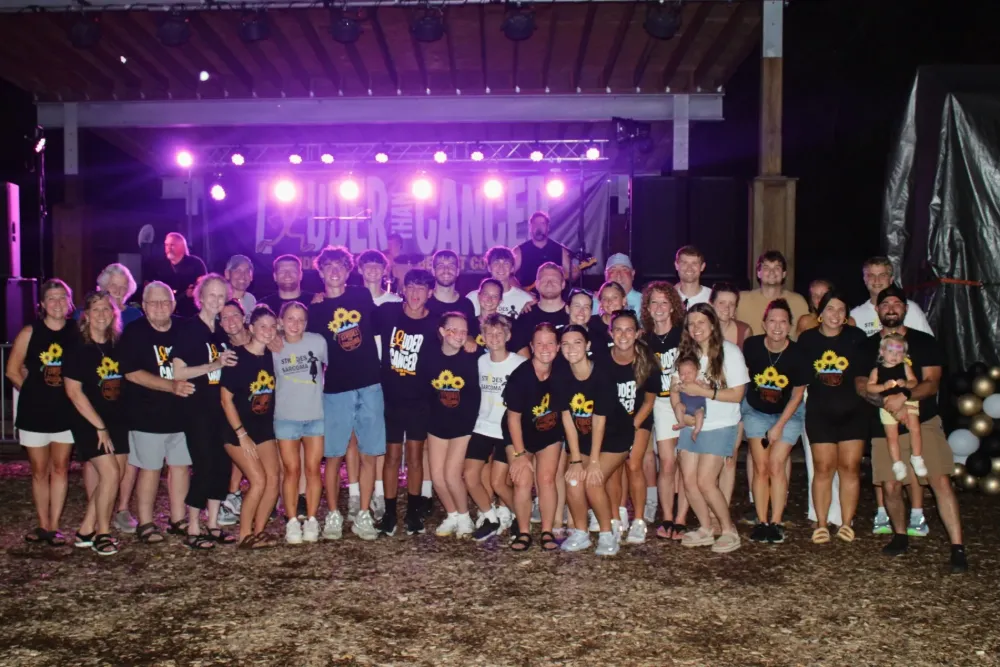
The annual Louder Than Cancer benefit concert remains Strides’ biggest annual fundraiser, attracting over 1,000 participants and raising $82,000 in 2026.
Currently, the Strides team is engaged in its largest annual warrior support effort: Stockings for Sarcoma. Each year, they prepare about 50 care packages for the holidays including things for the cancer journey like nausea lollipops and Warmies — cute plushie animals that can be heated in the microwave for therapeutic comfort — along with specific items on each child’s wish list. This year, they plan to hand-deliver stockings to children at Riley Hospital and Peyton Manning Children’s Hospital.
“They’re not just a generic care package,” Gabriella said. “We try to be mindful of things they can do inpatient, but at the end of the day, these kids just want to be treated like kids, and we try to make them feel extra special during the holiday season.”
 Strides also sends out personalized care packages and birthday cards throughout the year. Any family experiencing childhood sarcoma can fill out a form to request support. To date, Strides has shipped 150 care packages to children living in 30 U.S. states and five countries.
On the research side of the mission, Strides anticipates getting 15 to 20 applications for the 2027 Maia James Sarcoma Innovation Grant of $75,000. Applications are reviewed by a board consisting of healthcare professionals, students and family members.
The Conjelko twins are hands-on leaders of the nonprofit they founded, but now, as busy medical students, they are learning to delegate more tasks.
“The past three years, it’s been predominantly my brother and I who organized everything,” Gabriella said. “Last year, we sent out over 400 emails just for sponsorships alone. Now we have a sponsorship committee, a silent auction committee, an event committee and lots of other committees.”
By the time she and Nicholas become pediatric oncologists, Gabriella is confident that Strides for Sarcoma will have raised over $1 million for research grants and family support programs. “We hope to do two grants a year of $100,000 to $200,000, specifically funding pediatric sarcoma,” she said.
“Our mission and our goals run parallel alongside our prioritization of never letting the memory of Maia diminish,” added Nicholas. “Although balancing Strides with the continuous demands of medical school will not be easy, keeping up with Strides and helping other pediatric warriors is what keeps us going.”