Ivana Daniels has spent countless hours at the microscope studying viruses that infect the human airway. After a day in the lab, she often leads hot Pilates classes, urging participants to push through the discomfort as they sweat it out together in a 100-degree studio. Both science and Pilates have taught her the same lesson: when things get hard, you just keep going.
And it’s better when you’re in it together.
In Pilates, the reward for endurance comes at the end of an hour-long workout. In the lab, it takes much longer. Each discovery — or failure — redirects the long course toward scientific breakthrough.
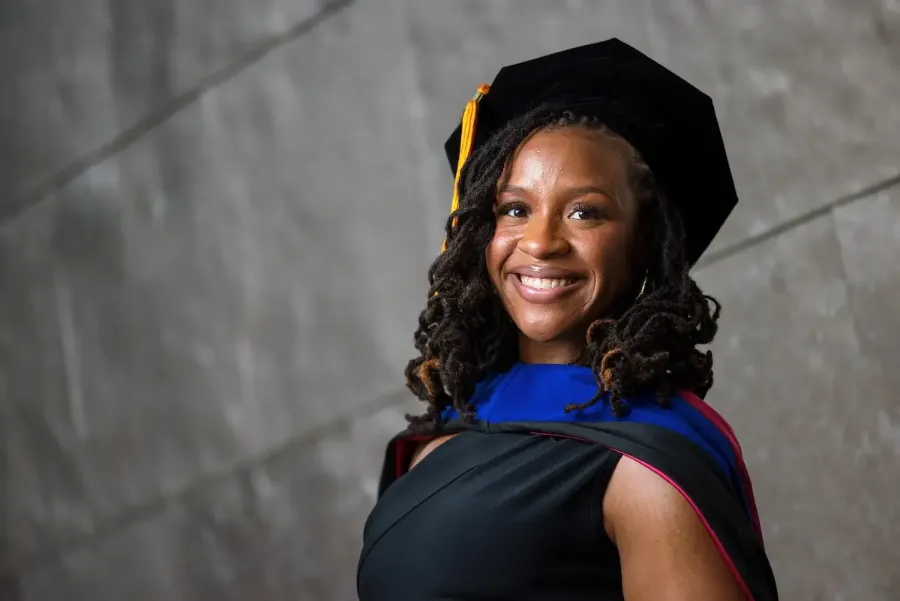
Daniels’ perseverance has brought her to a major milestone: earning her PhD in pharmacology. Recently recognized among the IU Indianapolis Elite 50, Daniels was selected to represent graduate students at both the IU School of Medicine Graduate Recognition on May 15 and the IU Indianapolis Commencement on May 16.
As she reaches this educational milestone, Daniels encourages her peers to embrace the uncertainty ahead.
“When people imagine scientific discovery, they often picture a breakthrough — a sudden answer,” she said. “But those of us who have lived through graduate school know the truth: discovery rarely looks like certainty. More often, it looks like unanswered questions, failed experiments, unexpected results, and the quiet persistence to keep going anyway.”
The road ahead might look uncertain for many master’s and PhD graduates as they face a competitive job market and a myriad of options for their career paths. If anyone is prepared to face this uncertainty, it’s a scientist, Daniels said.
“Every experiment begins with the possibility that we might be wrong,” she said. “Every hypothesis risks failure. And every discovery begins with a question no one has answered before.
“Yet we continue — not because we are certain, but because discovery demands that we try.”
From musician to medical scientist
Daniels’ path to a PhD in pharmacology was itself filled with uncertainty. Growing up in Richmond, Virginia, Daniels’ parents invested heavily in her musical education. Her mother played the flute and French horn, and Daniels shared that musical bent. She successfully auditioned for admission to a fine arts magnet school where half of her classes focused on musical performance and production.
But a middle school STEM program introduced her to another passion: science and math. In 10th grade, she joined a NASA-sponsored extracurricular program.
“A lot of my peers wanted to be engineers or astronauts, but I found myself more curious about the human health aspects of space exploration, which led me to explore biomedical engineering and eventually sparked my interest in premed.”
At the University of Virginia, Daniels majored in biology and religious studies and continued working with NASA through its Virginia Space Grant Consortium scholarship program. She also shadowed several doctors, but the only specialty that captured her interest was pathology.

“I really liked being in the lab,” she said.
During her sophomore year at UVA, she started working in a biochemistry lab with research focused on pulmonary hypertension and treating antibiotic-resistant bacterial infections. Daniels worked as a molecular medical technologist, processing high volumes of diagnostic tests during the COVID-19 pandemic. The experience solidified her interest in respiratory research.
That led her to apply for a job in the lab of Benjamin Gaston, MD, at the IU School of Medicine. When Daniels chose to pursue her PhD, she also chose to stay in the Gaston Lab and make Gaston and Michael D. Davis, PhD, her mentors. Along with their shared scientific interests, all three are Virginia natives, so the lab felt like “home away from home” for Daniels.
“Ivana has become a leader in our lab’s virology and cell culture experiments,” Gaston said.
Since 2021, she’s given more than two dozen presentations on their collaborative work contributing to the understanding and potential treatment of respiratory diseases, including cystic fibrosis, RSV, asthma and human metapneumovirus.
“She has demonstrated potential treatment for two viruses that have no known treatment in the world — and that’s all her work,” Davis said. “She’s expanded our patents and is now on the patent for our antiviral drug because of this work.”
Daniels’ numerous awards and travel grants include recognition as a student scholar with the American Thoracic Society and a scholar with the International Collaborative Asthma Network. Gaston sees Daniels as “a leading scientist in her generation.”
“People like Ivana who actually know how to discern scientific truth will ultimately be in great demand and will be essential leaders,” he said.
As a PhD graduate, Daniels plans to pursue a role that connects academia and industry, with a focus on scientific communication.
“I want to be somewhere I’m still connected to the science but I’m also able to use my voice to communicate and educate others on what is happening behind the curtains of drug discovery,” she said. “I’m hoping to use the skills I’ve built here at IU to be an effective scientific communicator and bridge the gap between science and patient care.”
Mentoring and advocating for representation in science
“I first recognized the gap in representation during my time at NASA, where the presence of Black students was strikingly limited,” said Daniels, who stands out as a Black woman in science.
The program’s director, however, was also a Black woman who became a longtime mentor for Daniels and instilled the importance of representation. Daniels began volunteering at STEM events for children and became a representative for the NASA Bridge program designed to connect underrepresented students with research opportunities.
At IU, she’s mentored several undergraduate and graduate students, speaking at recruitment events for the Summer Undergraduate Research Experience in Biomedical Science program and serving as a peer mentor with the school’s Initiative for Maximizing Student Development. She’s also a wellness coach and was recognized as Student Mentor of the Year within the pharmacology department.
“One of my undergrad students just got into the MD/PhD program,” Daniels proudly reported.
Daniels calls mentoring “extremely vital” and recognizes the impact of mentors in her own life, particularly Sabrina Absalon, PhD, a malaria researcher whom Daniels asked to chair her PhD thesis committee. While Absalon’s scientific and career mentorship has been useful, their mentoring relationship goes much deeper, plunging into personal life matters over casual lunches.
“She’s my No. 1 cheerleader and supporter,” Daniels said. “She’s also built a lot of my confidence in science.”
Absalon said she became less of a committee chair and more of a “big sister” to Daniels — sharing struggles, celebrating wins and learning from each other.
“What I admire most about Ivana is how much she cares, not just about her own trajectory, but about the people around her and the community she is part of,” Absalon said. “That care translated into real action: she took on leadership roles within the department and the school, and she was recognized for it, including receiving a departmental mentoring award.”
Daniels is a natural leader who genuinely wants to facilitate progress, added Absalon.
 “She kept her eyes on the science and on the future while also doing the harder work of pushing that environment toward something better,” Absalon said. “I have learned an immense amount watching her do that with grace and resilience.”
Daniels approaches her work in the lab in the same manner — fearlessly.
“That combination — independent drive paired with the humility to ask for guidance — is one of the hallmarks of a scientist who will have a long and impactful career,” Absalon said.
As she looks to her future, Daniels remains eager to explore big questions that could lead to breakthrough medical discoveries.
“If graduate school has taught us anything, it is this: we are ready for uncertainty,” she encouraged her peers. “We are ready to lead. And we are ready to continue the work of discovery that will shape the future of science and medicine.”