If Scott Boden, MD, could go back to his freshman year as a first-generation college student at the University of Pennsylvania, he might tell himself to have more confidence. Never in a million years would he have believed he would one day be leading the nation’s largest MD-granting medical school.
If his 18-year-old self could see him now — as dean of the Indiana University School of Medicine — he would “probably not believe that I ever wrote a (scholarly) paper, that I was ever able to compete with the smart kids, would not believe that I actually have a World Series ring with my name on it … and wouldn’t have thought I’d end up with five kids that are even more impressive than their dad.”
Despite selecting his undergrad courses specifically to avoid writing papers, Boden now has 230 scholarly publications to his credit and is one of the most cited spine surgeons. His 2021 World Series ring — and a spot in the Atlanta Braves victory parade carrying the trophy — was an honor he earned by forging a sports medicine partnership between the team and Emory University while Boden was chair of its Department of Orthopaedics. He also brokered deals with several other sports franchises including the NBA’s Atlanta Hawks.
And the kids? All four of his daughters are now orthopedic surgeons like their dad, while their brother is forging a career in finance. Boden met his wife, Mary, at the University of Pennsylvania School of Medicine, where she studied internal medicine and later became the regional vice president and senior medical director for Cigna Healthcare before retiring.
“She shared all the same values in terms of education as a priority, doing your best, working hard and staying actively engaged with the kids,” Boden said. She also served as his personal editor for his first academic publication.
 Boden’s very first case study turned into a lead feature article published in the top orthopedics journal with an editorial. He realized it was more than “beginner’s luck” when his next two papers achieved similar success, the third being published in the New England Journal of Medicine — an “unheard of” feat for an orthopedic surgeon.
“I just love that whole process of finding out something nobody else knows, designing the study, communicating it, and then the challenge of selling it to a journal in a way that they want to publish it,” Boden said. “Then I enjoyed traveling to meetings and speaking about it. I sort of discovered a side of me that I didn’t know before — that’s how it all started for me.”
Today Boden is known as an innovator in spine surgery, as well as in academic medicine. His keen mindset for business stems from his upbringing in the New York Tri-State Area, where his father worked for a Manhattan-based butter, eggs and cheese business that supplied restaurants, country clubs and cruise ships, along with school and hospital cafeterias. Neither of his parents graduated from college, but they prioritized education for their three children.
His dad, Herb, got to work at 3:30 a.m., six days a week, to load the trucks before moving to the office after breakfast to start sales calls. Boden often tagged along and later worked alongside his dad in the business.
“That’s where I learned the principle that ‘the customer is always right,’ and I learned how to operate a small business with very thin margins,” Boden said. In retrospect, he notes, the wholesale food business wasn’t too different than the healthcare industry of today: everything centers on the patient experience.
“Healthcare has turned into a customer service concept, if you’re doing it right,” he said. “And there are lean margins.”
The last time Boden didn’t have a plan
Throughout his educational and career journeys, Boden has combined curiosity with hard work and persistence. People who know him have difficulty believing there was ever a time he didn’t meticulously chart his path to a desired goal. Yet he meandered his way into medicine and then into the specialty of orthopedic surgery, despite having never broken a bone in his life.

In high school, Boden recalled, he had to study “three-to-five times harder” than his peers in the honors program. He compensated with work ethic, curiosity and an entrepreneurial spirit. As a kid, Boden wrote to companies asking for bumper stickers and then sold them to his classmates. His knack for making a pitch has served him well throughout his career.
Many of his ideas come from an innate curiosity and a bent for tinkering that was evident from an early age.
“I loved taking things apart and putting them together,” Boden said. “I used to take old Bell telephones apart and convert them from dial to push button. I tried to build a little mini-computer before there were chips — a machine that would basically create different scenarios for tests and questions and answers.”
Despite initial discouragement from his high school guidance counselor, Boden applied to an Ivy League school and gained admission to the University of Pennsylvania, where he started on the pre-dental track. He wanted to have a practice like his hometown orthodontist — until that orthodontist persuaded him that he’d find greater opportunities in medical school.
Boden studied hard to improve his initial “mediocre” score on the Medical College Admissions Test (MCAT) and landed a spot at Penn’s medical school. There, he took the advice of a peer who told him he should do research with a certain professor, leading Boden into the fascinating field of orthopedics.
“I went to med school having no idea about anything to do with medicine, other than it relied on math and science and it helped people,” said Boden, who later completed his orthopaedic surgery residency at The George Washington University and a spine surgery fellowship at Case Western Reserve University.
“Most people that have met me since I’ve been in practice and in physician leadership actually think that I plan every detail of everything,” he said. “They hear this story and think it’s totally incompatible with the version of me that they know. But literally, I had no plan.”
Boden grinned: “Maybe that was the last time I had no plan.”
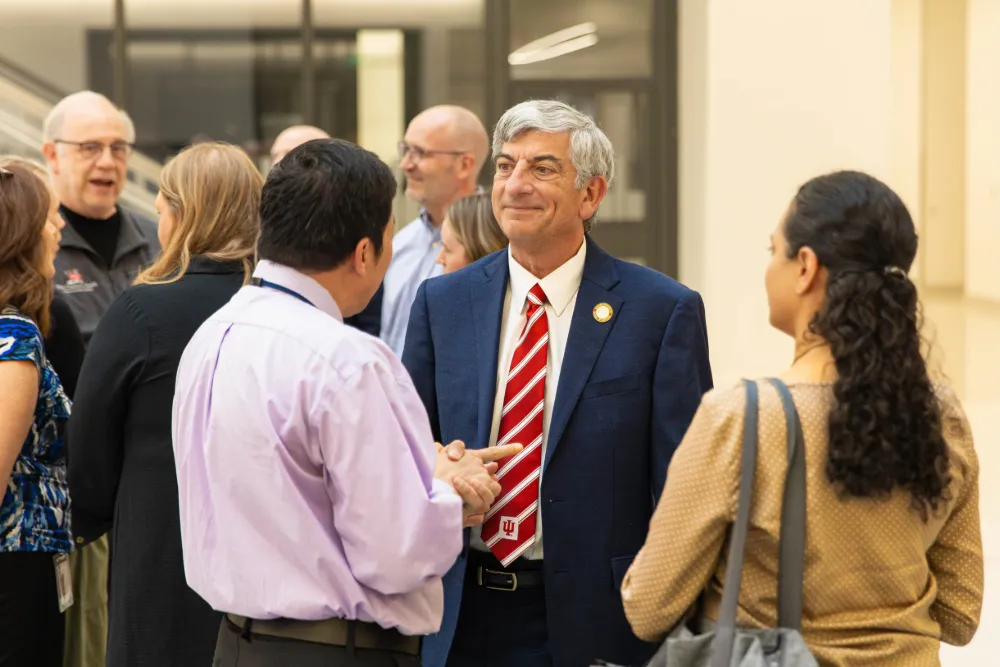
As the 11th dean of the IU School of Medicine, Boden has spent his first few months listening — he toured all nine campuses in his first 50 days. Now he’s busy making plans for capitalizing on the school’s strengths.
Boden sees potential for innovating in education, broadening all Hoosiers’ access to healthcare, accelerating the pipeline from lab research to clinical trials, and growing infrastructure for “ambitious science,” he told faculty, staff and students during his first All-School Meeting in October.
“Part of good strategy is deciding what deserves extraordinary attention — and what does not,” he said.
An example and encourager for first-gen med students
November 8 is National First-Generation College Celebration Day, which honors the experiences, resiliency and achievements of students and leaders who were the first generation in their immediate families to obtain a bachelor’s degree.
At the IU School of Medicine, about 13% of medical students identify as first-gen. The First-Generation Student Committee aims to help these students build a supportive network.
Sophie May likens being a first-generation student to trying to assemble a puzzle when you haven’t seen the picture on the box: “You’re just kind of figuring it out along the way. It takes persistence and resilience.”
She appreciates having leaders at the school who demonstrate that high achievement in academic medicine is possible, even when a person’s background is non-traditional for the field.
 Along with Boden, first-generation students can look to Bradley Allen, MD, PhD, the school’s executive associate dean for educational affairs, who describes himself as “a native Iowan farm boy” and proud first-generation graduate of the University of Iowa, where he earned his BS, MD and a PhD in microbiology. Allen sees Boden as someone who exemplifies the intellectual curiosity and perseverance that enable first-gen students to become strong leaders.
“He has worked hard in competitive training programs and professions and benefitted from the flexibility and innovation in approach to his work and his leadership style that come with the viewpoint of a first-generation individual without preconceived expectations,” Allen said.
Allison Stogsdill, co-president of the First-Generation Student Committee, said having school leaders who identify as first-gen “provides a sense of relatability and belonging.”
“When you are a first-generation student, it is incredibly easy to feel imposter syndrome,” she said. “Many of us did not grow up personally knowing physicians or researchers, so having a leader at IU School of Medicine that is first-generation demonstrates that there isn’t one particular background or path that defines a career in medicine.”
Boden’s advice for first-generation students is to “not worry if they’re not exactly sure what they want to do at the end of it all.”
“I would just say work your hardest to learn because you’re not learning for tests — you’re learning for your future patients,” he said.
Resources and networking for first-generation students at IU School of Medicine
First-generation medical students commonly feel insecure about having fewer connections or knowledge of the academic process compared to peers with family members in medicine or higher education. The First-Generation Student Committee hosts a breakfast during orientation week and quickly connects incoming students with peer mentors who are a year or two ahead.
“Especially when entering med school, it can feel like everybody knows what they're doing or what comes next, but you don't,” May said. “Mentorship and connecting with other first-gen students helped me realize that there were so many others like me and shared my sense of insecurity in not knowing.”
 The student-led committee connects first-gen students across all nine IU School of Medicine campuses and helps them build support systems.
“The First-Generation Student Committee is really centered around creating a sense of community and a platform for advocacy,” said Stogsdill, a third-year student on the Terre Haute campus. “In particular, this might include addressing lack of professional connections, navigating the hidden curriculum and costs of medical school, and balancing personal and academic expectations.”
The committee hosts several events throughout the year. A research information night on Dec. 1 will emphasize the value of doing research and highlight ways to get involved. That event is open to any first- or second-year IU School of Medicine students who want to learn more.
In the spring, the committee will host a post-Match panel discussion with IU School of Medicine’s graduating first-gen students to help their junior peers navigate the process of selecting a medical specialty.
First-Generation Medical Students can find more resources on the IU School of Medicine Medical Student Portal, including external resources like the AAMC’s Tools and Resources for First-Generation Medical School Students. IU medical students who are interested in getting involved in the First-Generation Student Committee may email committee co-advisor Niki Messmore.