
Pediatrics Residency Curriculum

Residents visit patient while in the Pediatrics Residency CurriculumA comprehensive curriculum for the Pediatrics Residency includes primary care pediatrics, subspecialty care, critical care and care for the community as well as opportunities to pursue medical research and experiences in global health and community health. The majority of rotations are based at Riley Hospital for Children at IU Health on the IU School of Medicine—Indianapolis campus. Other rotations occur at Eskenazi Health Sidney & Lois Eskenazi Hospital, the county hospital located across the street from Riley Hospital, and at IU Health North Hospital in suburban Carmel.

Following ACGME guidelines, over a three year residency, our residents spend 40 weeks on inpatient rotations, 40 weeks on outpatient rotations, 40 weeks on an individualized curriculum, and 24 weeks that are up to program discretion. Residents also get four weeks of vacation per year, split into one two-week block and two one-week blocks. Residents get to individualize their educational needs by joining one of our clinical tracks in order to optimally prepare for their chosen field.

Our residency program and educational experience is constantly evolving based on resident feedback and preferences.
Residency Council

Our residency council is a committee of residents from each class that are selected by their peers to serve as the voice of their class as a variety of topics are discussed including scheduling, curriculum, resident wellness and much more.


Curriculum Highlights

Orientation

Orientation for new residents occurs in early June each year. Orientation will not take place on June 19, 2026, or on weekends during the orientation period. Onboarding will be followed by a clinical start date of June 24, 2027.


Clinic

Residents are placed in a variety of clinics located around the city ranging from private practice to FQHC clinics. Clinic placements are determined by resident preferences which allows the clinic experience to be personalized to fit resident career goals.


Camp Riley

Residents are provided the opportunity to participate in Camp Riley, which is a camp dedicated to Riley patients that is run by Riley staff and supported by Riley nurses. This gives residents the chance to spend time with each other, connect with nursing staff and campers, enjoy time outdoors, build clinical skills, and earn some extra income.


Career Planning Elective

Residents receive protected time for career exploration during their final year of residency. This rotation serves as dedicated time for fellowship or job interviews and career reflection.


Acting Fellow Elective

Residents who are pursuing fellowship are provided with a month-long rotation within their subspecialty of choice during which they can shape learning experiences to strengthen their preparedness for fellowship.


Jeopardy

We have a “no fault” jeopardy system in which jeopardy shifts can be activated without the resident being penalized for use of jeopardy.


Sample Rotation Schedule

We follow an X+Y curriculum that we call “XYZ.” Residents spend four weeks on an X rotation, when they do not go to clinic; two weeks on a Y rotation, when they go to continuity clinic one day per week; and two weeks on a Z rotation, when they spend time doing longitudinal experiences and go to continuity clinic one to two days per week.

PGY1

X

Y

Z

NICU 1 ED Ambulatory
Hospitalist / Night Float 1 ED Community / Advocacy
Hospitalist / Night Float 2 Individualized Curriculum Subspecialty Outpatient
Complex Care Individualized Curriculum — SS Vacation — two one-week blocks
Hematology-Oncology Newborn Nursery  
Pulmonology Vacation — two week block  
Developmental-Behavioral Pediatrics    


PGY2

X

Y

Z

PICU 1 ED Mental Health
NICU 2
ED
Resident as Teacher
Ward Senior Individualized Curriculum
Individualized Curriculum
Cardiology Ambulatory — Urgent Care
Individualized Curriculum — SS
Adolescent Medicine Admit Resident
Vacation — two one-week blocks
Endocrine / Night Float
Vacation — two week block  
Individualized Curriculum      


PGY3

X

Y

Z

PICU 2
Newborn Nursery
Ambulatory
Subspecialty Senior
Hospitalist — IU Health North
Board Preparation
Ward Senior / Night Float   Individualized Curriculum
Individualized Curriculum
ID / Renal
Ambulatory — Private Practice
Individualized Curriculum — SS
ED Admit Resident
Vacation — two one-week blocks
GI / Other Subspecialty
Vacation — two week block
 
Individualized Curriculum
   

Teaching Conferences

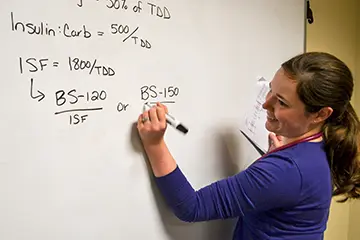
Faculty member uses white board for lesson. Excellent clinical experiences are supplemented with educational conferences. Beginning in 2025, we are transitioning to an academic half day during the Y and Z blocks where we will focus on ambulatory topics and hands-on sessions. We will hold daily inpatient rotation-specific lectures during X blocks. Annual retreats off campus allow for extra workshops on topics like teaching, communication, leadership and practice/financial management.

Educational Topics

All residents become certified in Pediatric Advanced Life Support (PALS) and Neonatal Resuscitation Program (NRP). 

Boards Review is a part of a coordinated curriculum provided by expert lectures from across fields of pediatric care. Emphasis is placed on topics which are critical information for the clinically astute pediatrician. 

Led by the pediatric emergency medicine faculty, residents are led through simulation sessions that allow them to practice important procedural skills, from splinting to ultrasound to laceration repair and more. 

Grand Rounds are held on Wednesday mornings weekly. Faculty, residents, students and staff attend presentations by visiting lecturers or IU School of Medicine faculty, which encompass timely topics such as new clinical advances, research contributions, updated clinical reviews or health care news. 

Journal Club is a resident-lead activity with small group sessions every month. The activity follows a curricular schedule to prepare residents to assess the specific types of common literature formats.

Residents expand their presentation skills throughout training with dedicated opportunities to present each year. As intern residents present a case, as PGY2's residents lead a Morbidity and Mortality conference, and as PGY3's residents present a senior project. 

Each year, pediatric residents have a half day of simulation exercises at the state-of-the-art Simulation Center at Fairbanks Hall. These sessions provide rich learning environments for trainees to practice key clinical skills, develop high-quality teamwork and improve communication skills in a safe environment.