Mothers and babies all around the world face numerous, intersecting barriers to optimal social, economic and health outcomes. In Indiana, mother-baby dyads in rural communities, those impacted by incarceration and minority populations (including recent immigrants) are especially vulnerable. To address the multi-level factors contributing to unfavorable outcomes for vulnerable mother-baby dyads, the Grassroots MCH Initiative is advancing individual- and systems-level change through community-based interventions and partnerships with social service organizations, and it is now expanding into peer navigation of health services for mothers and babies with chronic health needs. Under the leadership of Jimmy Carlucci, MD, MPH — who has expertise in infectious diseases, implementation science and global health — the Grassroots MCH Initiative is pursuing this agenda through the lens of reciprocal innovation.
What is Reciprocal Innovation?
Reciprocal innovation is the bi-directional and iterative exchange of a technology, methodology or processes between at least two contexts to address a common challenge and provide mutual benefit to both sides. Lessons learned flow both ways, adapting to each setting’s needs and infrastructure.
What is Peer Navigation?
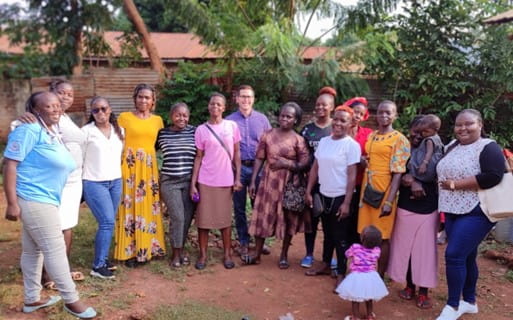
Peer navigation leverages trained peers with lived experience to provide coaching, linkage to services and retention support, an approach that has demonstrated success in improving maternal and child health outcomes globally. For example, Mentor Mother programs in Africa have shown that peer support can significantly improve engagement in care and health outcomes for mothers living with HIV and their babies, offering tailored, person-centered guidance in resource-constrained settings. Building on Dr. Carlucci’s NIH-funded research in Kenya and these proven principles, the Grassroots MCH Initiative now seeks to adapt and expand peer navigation models to support vulnerable mothers and babies across a range of chronic conditions in Indiana. Peer navigators will also be trained as Grassroots MCH leaders, equipping them with leadership skills to advocate for systemic change and strengthen community capacity. Using a human-centered design approach, drawing on prior collaborations with the Indiana CTSI, we will ensure that strategies are contextually tailored, culturally responsive and co-created with the communities they serve. Through reciprocal innovation, we aim to create scalable solutions that strengthen care systems, promote equity and improve outcomes for mother-baby dyads facing complex health and social challenges.
Program Goals
Building on the Grassroots MCH Initiative’s strengths, these new reciprocal innovation of peer navigation efforts will include:
- Reciprocal Innovation — In partnership with the IU Center for Global Health, we will leverage the Grassroots MCH Initiative’s access to vulnerable populations in Indiana to adapt and implement evidence-based approaches to peer navigation developed in resource-constrained settings where scarcity and task shifting drive efficiency and impact.
- Health Systems Change — The Grassroots MCH Initiative will expand its scope to effect health systems change through implementation of peer navigation for vulnerable mother-baby dyads with chronic conditions (e.g., HIV, hepatitis B and C, and sickle cell disease).
- Global Expansion — Just as peer navigation can be adapted from African settings to Indiana, the Grassroots MCH leaders model will be adapted to other contexts (e.g., AMPATH) for broader impact.
Partners
- AMPATH (Academic Model Providing Access to Healthcare)
- Indiana University Center for Global Health
- Research Jam, the human-centered design core of the Indiana Clinical and Translational Sciences Institute